

For the past couple of weeks, the mainstream press has been talking a lot about gene-edited human embryos, after a new, controversial breakthrough.
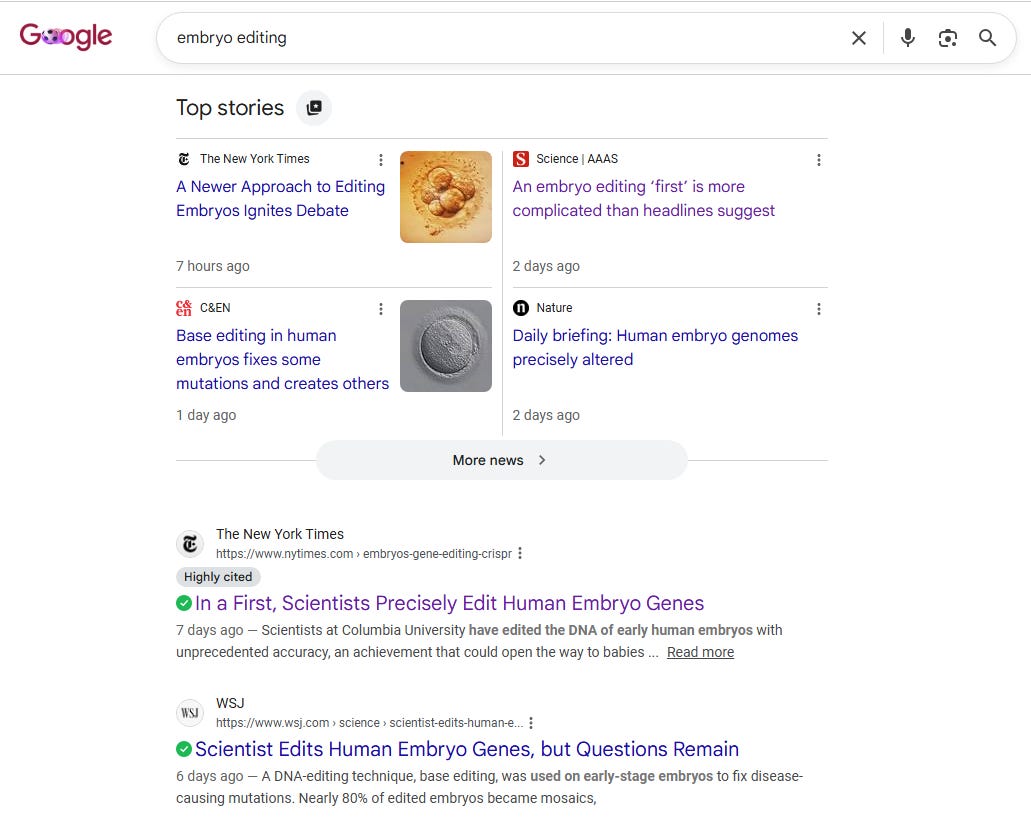
In early June, a team led by the Columbia stem-cell scientist Dieter Egli published a study describing the editing of single DNA letters in human embryos, and the New York Times ran it under the headline “In a First, Scientists Precisely Edit Human Embryo Genes.” Other outlets echoed the framing, and the words “designer babies” were back in circulation within a day.
The phrase still detonates for reasons that predate any recent experiment. Concern about engineering human heredity is more than a century old: it traces through the twentieth century’s eugenics movements and the atrocities they produced, and by the late 1990s, it had been written into international protective instruments — UNESCO’s 1997 declaration on the human genome called altering the germline a potential affront to human dignity.
The germline is the genetic material in eggs, sperm, and embryos that passes to every future generation. Editing a person’s non-germline cells (somatic cells) affects only that person’s fate, but editing the germline changes what descendants inherit, permanently altering the biological fate of future generations.
The taboo on embryo gene editing was broken recently in a scandalous experiment in China: in 2018, the Chinese scientist He Jiankui announced the birth of twin girls whose embryos he had edited with CRISPR, which was condemned worldwide, and Jiankui was later sentenced by a Chinese court to three years in prison.
And the experiment did not even work as intended. The geneticist Kiran Musunuru, who reviewed He's unpublished manuscript, described the result in MIT Technology Review as "attempted gene editing gone awry": the edits did not take uniformly, leaving both girls likely "mosaic," with different cells carrying different changes, and possibly some carrying unintended edits no one ever detected. Just as troubling, the work has never been fully verifiable. He never published it or opened his data to independent scrutiny, so outside scientists cannot confirm what was done to the twins, whether it is safe, or how they are faring now.
Coming back to the latest Columbia-born breakthrough, we have to calibrate its real merit over the hype. As the more careful media coverage caught up, it became clear that this was not a first, and that the advance was both narrower and more complicated than the initial wave suggested. Even the New York Times quietly removed the word “first” from its online headline shortly after publishing.
The science here is real but slow, still hemmed in by safety problems that are nowhere near solved. But here’s the thing about this sort of foundational technology: it tends to move slowly for a long time, and then suddenly reshape life. That’s more or less how the AI revolution happened to us, suddenly, in late 2022, when ChatGPT was first released. Like it or hate it, it was a moment that changed the way we knew life in the digital world before the LLM revolution. And what really strikes me is the imbalance: it took an enormous effort — armies of scientists, engineers, and countless others at universities and companies, over decades to create foundationla AI theory and technology, and yet, a remarkably small number of people ended up with the concentrated power to decide how it gets used and distributed, basically dictating how millions of us write, search, and work each day. So it’s worth asking: could human embryo editing end up on a similar path?

What actually happened
Egli's team took human embryos donated from IVF clinics and used a technique called base editing to change a single letter of DNA at two locations.
Base editing is a high-precision gene-editing technology that allows scientists to make single-letter changes to a DNA or RNA sequence without breaking the molecular backbone. It acts like a "pencil" that rewrites individual genetic letters, offering a much cleaner alternative to traditional CRISPR-Cas9, which acts more like "molecular scissors".
So, at one site, Egli’s team switched off PCSK9, a gene that helps regulate "bad" cholesterol. At the other, they altered the HBG genes that govern fetal hemoglobin — a change of the kind that could one day matter for sickle cell disease. The embryos were never intended for pregnancy; they were studied and then destroyed.
Notably, the team did not correct any disease. They inserted changes into healthy embryos because, as Egli explained, it is hard to obtain donated embryos that carry the specific mutations one would want to fix. So the experiment was a test of the tool, not a treatment of a patient, a point that several scientists seized on, since research on human embryos is usually expected to point toward some eventual therapeutic benefit.
What Egli’s group worked out was how to base-edit at the single-cell stage without the embryos failing to develop, the obstacle that had defeated earlier attempts. The standard method delivers the editing instructions as messenger RNA, which the team found is toxic to a newly fertilized egg; their fix was to inject the editing protein itself, made in advance, along with the guide molecule. The embryos then developed further than before.
There remain at least two unsolved problems.
The first is off-target editing: even here, the supposedly precise tool sometimes altered genes it was not aimed at — and the methods for detecting such stray edits are struggling to keep up. Base editors leave a subtler signature than older tools, a nick in one strand rather than a clean double cut, and in April 2026, the FDA warned that standard tests built for double-strand breaks may miss exactly these single-strand nicks. The safety simply cannot yet be verified, even in ordinary therapy, let alone in an embryo meant to become a person.
The second is mosaicism. Even at the single-cell stage, the editor often missed some copies of the target gene, leaving an embryo whose cells do not all carry the same edit — a patchwork, not a correction, and the same flaw that appeared in He Jiankui’s experiment.
So the breakthrough is essentially a delivery trick that lets a known technique work slightly earlier and slightly more cleanly than before. Egli himself is measured about it. The findings will “shift the conversation,” he has said, “but it won’t change the landscape of use anytime soon.”
A short history of cutting DNA
To see why even a modest step in embryo gene editing draws this much attention, it helps to know how short and how fast the history of gene editing is.
The ability to deliberately alter DNA is barely fifty years old. In the early 1970s, scientists learned to cut and splice DNA using bacterial “restriction enzymes,” producing the first recombinant DNA — the achievement that, within a few years, let engineers insert a human insulin gene into bacteria and grow medicine in a vat. The power was so obviously double-edged that in 1975 the field paused itself, gathering at Asilomar in California to agree on voluntary limits before continuing. That instinct to build a tool and then immediately argue about its restraint has shadowed the discipline ever since.
For decades, the gene editing tools were clumsy, though. The breakthrough that made gene editing a household idea came in 2012, when Jennifer Doudna, Emmanuelle Charpentier, and others showed that a bacterial defense system called CRISPR-Cas9 could be programmed to cut DNA at almost any chosen sequence. CRISPR caught on because it was easy: instead of engineering a new protein for each target, a researcher simply changed a short RNA guide. It won the 2020 Nobel Prize in Chemistry, and it works by cutting straight through both strands of the double helix and letting the cell repair the break, which is also its weakness, because cells repair such breaks imperfectly, sometimes losing whole stretches of chromosome.
Base editing, developed in David Liu’s Harvard lab in 2016, was the response to that weakness. Rather than cutting both strands, it chemically converts one DNA letter into another, thereby rewriting a single character instead of slicing the page. It is more precise and less destructive, which is precisely why it is the tool now being tried on embryos.
One of the scientists who built the first base editors, Alexis Komor, is the same researcher who, surveying Egli’s new work, remarked that “the cat’s out of the bag.”
The newest era in this historical line is not even about molecules at all. A 2024 Nobel Prize winner, Demis Hassabis, who runs Google DeepMind, argues that biology is at bottom an information-processing system, and that AI is its natural “description language” — a way to read and eventually write living systems at, as he puts it, “digital speed.”
That conviction is already reaching gene editing directly: in 2025, researchers unveiled CRISPR-GPT, an AI agent that designs editing experiments automatically, choosing the system, drafting the guide molecules, flagging off-target risks… This lowers the barrier for researchers who are not experts in computational systems or AI to design gene-editing experiments like never before. It is a long way from making designer babies a mainstream reality any time soon. Still, it points in the same direction the whole history of deeptech has run: each tool easier, faster, and more accessible than the last, eventually leading to unexpected developments.
That is the whole arc: from cutting and pasting genes in bacteria, to rewriting single letters in an embryo, to teaching software to design the edits in roughly the span of one scientist’s lifelong career.
The world has already drawn its lines, unevenly
Editing embryos that will become children is, in most of the world, forbidden. Dozens of countries ban the reproductive editing of sperm, eggs, or embryos outright.
The organizing principle nearly everywhere is the distinction between somatic editing, which changes the cells of an existing patient and cannot be inherited, and germline editing, which alters embryos or reproductive cells and passes changes to all future descendants. Somatic editing is broadly permitted and regulated as medicine. Germline editing for reproduction is the near-universal red line.
How that line is enforced varies sharply. Germany’s criminal code in relation to embryonic gene editing is among the most restrictive in the world. France permits research on surplus IVF embryos under tight control. China, after the He Jiankui scandal, wrote criminal penalties into its civil and criminal codes against implanting edited embryos, while still allowing tightly bound basic research. The United States occupies an unusual position: there is no federal law against the act of editing embryos itself. Instead, a funding rule known as the Dickey-Wicker Amendment bars federal money for research that creates or destroys embryos, and a separate provision blocks the FDA from even reviewing any application involving heritable editing. Dieter Egli’s work at Columbia University perfectly illustrates this split, as his team relied entirely on private philanthropy and institutional funds to conduct laboratory gene-editing research.
The result is not a wall but a patchwork, and patchworks are known to invite what bioethicists have called “ethical dumping” — the migration of experiments that would be illegal in one country to jurisdictions where the rules are looser or unenforced. He Jiankui’s experiment was itself partly that. As the technology improves, the question is less whether the world can agree to stop and more which jurisdiction will be the first to say yes, and to whom.
The market on the other side of the wall
While the science of editing remains stuck behind its safety problems, the business of selecting embryos has already opened for trade.
A cluster of companies now offers prospective parents the ability to screen IVF embryos using polygenic scores — statistical estimates that combine thousands of genetic variants to predict the likelihood of complex traits. The earliest of them, Genomic Prediction, markets strictly on disease risk, ranking embryos by their vulnerability to conditions like diabetes, certain cancers, and schizophrenia. Orchid Health, in California, sequences whole embryo genomes in its own labs and focuses on health/disease risk. Herasight scores embryos for psychological and physical conditions, but also crosses into height, body mass, longevity, and estimated cognitive ability.
And then there is Nucleus Genomics, whose founder, Kian Sadeghi, launched its embryo product with the line “Before there’s a heartbeat, there’s DNA.” In June 2025 the company launched Nucleus Embryo, software that lets parents compare up to twenty embryos across more than 2,000 conditions and generates probability scores not only for disease but for non-medical traits — eye color, height, longevity, and IQ among them. The launch drew immediate criticism; one venture capitalist said the product made her “so nauseous.” The founder was unrepentant, framing it as a parent’s right to know and asking, in effect, where the harm lay: if a couple chooses among their own embryos based on what matters to them, is that eugenics? “We have lost the plot,” he said.
The science underneath these scores could be shakier than the marketing implies. The U.S. National Human Genome Research Institute cautions that polygenic risk scores describe relative risk across populations, not destinies for individuals, and are not routinely used in clinical practice because there are no agreed guidelines for doing so. A score is a weather forecast for a crowd, sold as a portrait of one child. However, it remains to be seen how accurate and practically useful the tools prove to be.
But the accuracy of the scores is almost beside the point. What matters for the momentum of this story is that the consumer market seems to have come close to normalizing the act of reaching into the genetic profile of one’s possible children and ranking them. Selection is the on-ramp. Once choosing the embryo with the better scores is an ordinary purchase, fixing the letter that lowers a score might not be such a huge moral leap any longer, but more like a more advanced “feature“ of the otherwise morally and commercially accepted service.
After all, the philosophical distinction between selecting and editing might be thinner than it feels, according to some bioethicists. Because an embryo must be created before it can be edited, editing does not “treat” an existing person; it changes which embryo, and therefore which person, comes into being, which is essentially what selection does. Both are acts of choosing who exists.
The two worlds are likely to grow more interconnected, and in this study they already overlap. After all, Genomic Prediction, a company that sells polygenic and chromosomal screening of IVF embryos, contributed the chromosomal and SNP analysis for Egli's experiments, and three of the paper's authors are disclosed as shareholders or employees of it. None of that is hidden; it is stated plainly in the study's own acknowledgments and competing-interests declaration. But it is a concrete sign of how close the commercial business of screening embryos already sits to the science of editing them: the same firms, and sometimes the same people, work on both.
Where is this heading?
The companies selling embryo screening are still small, but the names behind them are not obscure. Orchid Health, the whole-genome screening firm, lists among its investors Figma’s chief executive Dylan Field, 23andMe’s Anne Wojcicki, Ethereum co-founder Vitalik Buterin, Replit’s chief executive Amjad Masad, and the Harvard geneticist George Church. Nucleus Genomics raised a $14 million Series A led by Peter Thiel’s Founders Fund and Alexis Ohanian’s Seven Seven Six, with a later strategic investment from Samsung Next. The sums are modest, and these are early-stage bets, not an industry. But it is a striking list all the same: to a notable degree, the people placing early money on reproductive genomics are the founders and funders of social media, software, and crypto, the same milieu that built the last technological wave now turning its attention to the genome.
Which brings me to the question from the title: will the embryo-editing revolution arrive the way AI's did and be concentrated in the hands of a handful of early movers?
Almost certainly not.
AI spread the way software spreads: trained once, copied everywhere at almost no cost, in hundreds of millions of hands within three years, and controlled centrally by just several tech corporations. Biology can't do that by the nature of things. Every embryo evaluation (and even more so — editing) is a physical procedure, every IVF cycle is slow and expensive, and every result is gated by regulators and the distributed physical infrastructure of modern healthcare. This will not scale at digital speed or anywhere close to it, and the fear that a few firms could capture all of human heredity runs into the sheer physicality of medicine.
But that same physicality points to a different problem. For all the power it concentrated, AI was at least distributed: its benefits, however lopsided, reached billions of people almost immediately and almost for free. Genetic technology can’t do that. It can’t be copied to a phone; it has to be administered, one expensive cycle at a time, to people who can already afford IVF and whatever screening or editing is layered on top. So if a real capability to shape a child’s genome ever does arrive, only a narrow group will be positioned to use it. AI concentrated control while spreading access; embryo editing could, at least at first, concentrate both.
This much is admittedly trivial — the same could be said of any expensive new medicine, and the usual reassurance applies: costly at first, cheaper and broader over time. But here the difference is more than economic. Curing a disease in a living patient is a universal good, celebrated even when it starts out available to only a few. Allowing a select few to choose a more favorable biological inheritance for their descendants just by “selecting features from a genetic menu list“ is something else entirely. I’ll leave that as an open thought, for everyone to weigh on their own.
Anyway, to summarize, the science, as the first half of this issue argued, is probably somewhat behind the hype around it, with all the unsolved safety problems etc, and a real capability to create designer babies may be a decade away or more. But the questions it raises do not wait for the science to be ready. Almost everyone agrees on the two ends of the spectrum: using this to spare a child a devastating inherited disease would be a profound good. The whole ethics of the coming decades lives in the territory between preventing diseases and enhancing traits, we will have to draw a line between avoiding a defect and choosing a preference... And that line is not written anywhere in nature. It is ours to draw through ethics, policies, and market behavior.
Sorry if my previous comment sounded a bit harsh! It was born out of a perspective that looks closely at the distinction between acute intervention and long-term systemic health. Gen-editing is the ultimate focus on 'software.' But if our biological 'hardware' is compromised by modern lifestyle constraints, even the most perfectly edited code won't save the system from running into chronic dissonance. There is absolutely no doubt about the monumental successes of medicine's pioneers!
This entire obsession with editing the genetic code is nothing but a collective illusion—a desperate attempt to patch the software because medicine is too afraid to face the physical reality of our collapsing biological infrastructure.